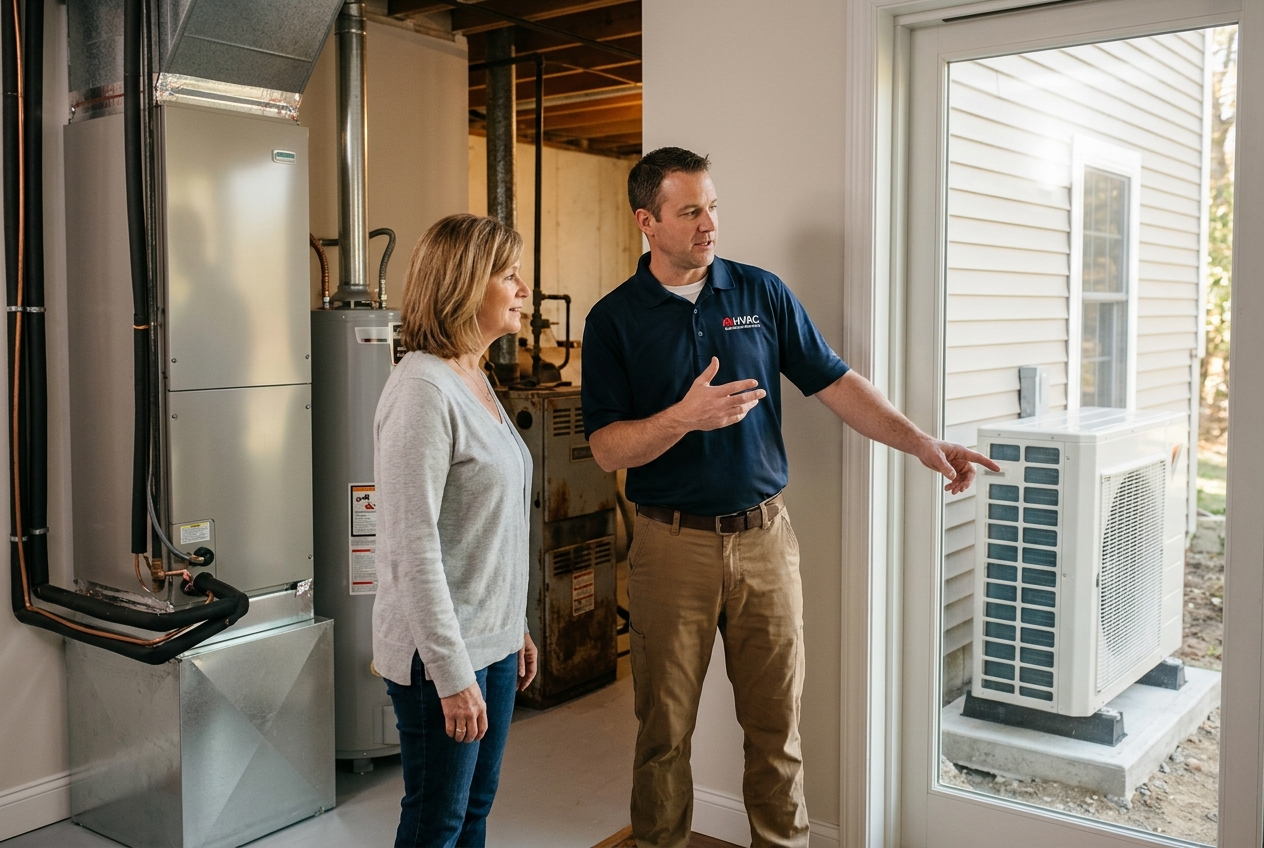
High Upfront Cost: Switching from oil heat to a heat pump typically costs between $14,000 and $26,000 before incentives.
Significant Savings: Homeowners in the Northeast can save an estimated $2,300 annually by switching from oil to a heat pump, due to higher efficiency and stable electricity prices.
Substantial Rebates: State and utility programs, especially in the Northeast, offer significant rebates, sometimes up to $14,000, to offset installation costs.
Dual Benefits: Heat pumps provide both heating and cooling, offering year-round comfort and eliminating the need for a separate AC system.
Homeowners in the Northeast face rising heating oil costs this winter. Brent crude oil traded around $106 a barrel in September 2026, marking an increase of over 30% since February.¹⁰ This volatility directly impacts the 5 million households in Northeast states like New York, Pennsylvania, Massachusetts, Connecticut, New Hampshire, Rhode Island, Maine, Vermont, and New Jersey that rely on oil heat.² Many are now considering alternatives, with heat pumps emerging as a key solution.
Switching from an oil furnace or boiler to a heat pump can cost between $14,000 and $26,000 before incentives, based on EnergySage Marketplace data from March 2026.¹ However, the long-term savings and available rebates often make this HVAC upgrade a compelling financial decision for those looking to escape the unpredictable expense of heating oil.
The Rising Cost of Oil Heat
The price of heating oil is deeply tied to volatile global commodity markets, which are beyond a homeowner's control. For the week ending March 30, 2026, the EIA's last official weekly reading for heating oil price was $5.535 per gallon.³ A typical 2,000-2,500 square-foot home in the Northeast uses roughly 800 to 900 gallons of heating oil annually.⁴
The National Energy Assistance Directors Association (NEADA) projects households using heating oil will pay nearly $2,300 for heating between mid-November and mid-March 2027. This projected cost represents a more than 30% increase compared to the previous year.² For homeowners, these rising costs highlight the need for more stable and efficient heating options.
Heat Pump Installation Costs
The total cost to install a heat pump system when converting from oil heat varies significantly based on system type, home size, and necessary upgrades. Most homeowners can expect to pay between $14,000 and $26,000 before considering incentives.¹
System Type and Capacity
The type of heat pump you choose heavily influences the overall cost.
Ducted whole-home heat pumps, which use existing or new ductwork, typically cost $12,000–$18,000 fully installed before rebates (Home Energy Basics, 2026). Cold-climate and variable-speed heat pump models are more expensive.⁵ For example, a whole-home cold-climate heat pump system for a typical Massachusetts home costs $15,000-$25,000 before rebates (NuWatt Energy, 2026).⁴ In Maine, similar systems range from $14,000 to $20,000 before rebates (Horizon Homes, March 2026).⁶
Ductless mini-split systems are another option, especially for homes without existing ductwork. A single-zone ductless mini-split costs $3,500–$5,500 installed. For multi-zone systems (2-4 indoor units), costs range from $6,000 to $14,000. While ductless mini-splits may have a lower cost per unit for multiple zones, they can result in higher overall expenses for larger homes requiring many zones.⁵ You can learn more about specific costs for ductless heat pumps.
Additional Installation Factors
Several other factors can add to the total installation cost:
Electrical Upgrades: Many older homes require an electrical panel upgrade to 200-amp capacity, which adds $1,500-$3,000 to the cost.
Ductwork: If your home lacks ductwork or needs modifications, expect to add $2,000-$5,000 to the installation cost.
Labor: Labor rates vary by region, with urban areas and the Northeast typically seeing higher costs, ranging from $3,000–$6,000 for installation.⁵
Oil System Removal: Removing the old oil furnace typically costs $50-$400, including disconnection and disposal. Many HVAC contractors include furnace removal in the installation price of a new system, often adding $60 to $330.
Oil Tank Removal: The cost to remove an above-ground oil tank (AST) is $500-$1,000. Underground oil tank (UST) removal can range from $1,500-$3,000 or more, depending on soil testing and potential environmental remediation.⁴
Operating Costs and Savings
The primary motivation for many homeowners to switch from oil heat to a heat pump is the significant reduction in operating costs. Heat pumps are 2–4 times more energy-efficient than oil furnaces, even in cold climates.¹ They operate by moving heat rather than generating it, delivering 2.5–4 kWh of heat for every 1 kWh of electricity consumed.⁷
Annual Heating Cost Comparison
The financial savings can be substantial. A typical Northeast household spends $2,864–$3,580 per year on fuel for oil heating.¹ In contrast, the estimated annual cost to heat a 2,000 sq ft home in the Northeast with a heat pump (electric) is $900/year (at $0.25–$0.33/kWh), assuming a cold-climate heat pump COP of 2.0–2.5.⁷ This compares to $3,200 annually for oil heat (at $4.00–$4.20/gal) for a similar home in the Northeast.
Overall, oil heat can cost about twice as much per BTU as a heat pump running on electricity in the Northeast. A typical winter electric bill increase of $80-$150/month with a heat pump is often offset by oil savings of $200-$350/month.⁷ As of March 2026, the national average cost per million BTU for heating oil was roughly $32, while for an air-source heat pump it was approximately $16.
Incentives and Rebates for Heat Pumps
The upfront cost of a heat pump can be daunting, but significant incentives and rebates are available, particularly in the Northeast.
The federal 25C Energy Efficient Home Improvement Credit (up to $2,000) for heat pumps expired on December 31, 2025, and is no longer available for equipment installed in 2026 or later.⁷ The Inflation Reduction Act, however, introduced new rebate tracks. The Home Electrification and Appliance Rebates (HEEHRA) offer up to $8,000 for qualifying heat pumps. These are income-based and administered at the state level, with varying launch timelines.⁸
State and utility rebates are now the primary incentives for heat pump installations.⁷
Massachusetts (Mass Save): Offers up to $8,500 for whole-home heat pump installation ($2,650 per ton). Income-eligible households may qualify for enhanced coverage, potentially reducing the net cost to as low as $4,000–$10,000 (after all incentives, including a 0% HEAT Loan). The Mass Save 0% HEAT Loan covers up to $25,000 for 7 years. Mass Save rebates for the top tier require heat pumps to be the sole heating and cooling source.⁹
Rhode Island (Clean Heat RI): Provides up to $11,500 (60% of costs) plus additional RI Energy rebates.
Connecticut (Energize CT): Offers up to $3,750 in incentives.
Maine (Efficiency Maine): Offers $1,000–$9,000 in incentives, serving as the primary incentive since federal credits expired.⁶
New Jersey: JCP&L offers $500 to $1,500 rebates for Energy Star-certified heat pumps.⁷ Atlantic City Electric (ACE) offers up to $2,000 for high-efficiency, cold-climate heat pump models.
New York: Offers some of the highest rebates, potentially up to $14,000 for income-qualifying households through stacked programs (Clean Heat + EmPower+ + HEAR + geothermal credit).
Some programs also offer bonuses, such as Mass Save's $500 for a home energy assessment and weatherization work.⁹ It is advisable to research your specific state and local utility programs for the most up-to-date rebate information. You can find more general information about incentives and financing for HVAC systems here.
Is Switching to a Heat Pump Right for You?
Converting from oil heat to a heat pump is a significant decision, but it offers numerous benefits, especially for homeowners in the Northeast. Approximately 80% of U.S. heating oil consumption occurs in the Northeast.²
Pros
- + Significant annual cost savings compared to oil heat.
- + More stable operating costs tied to local electricity rates, not global oil markets.
- + Provides both heating and cooling from a single system.
- + Reduced carbon footprint and improved energy efficiency.
- + Access to substantial state and utility rebates.
Cons
- - Higher upfront installation costs, potentially $14,000-$26,000 before rebates.
- - May require electrical panel or ductwork upgrades.
- - Performance can slightly decrease in extremely cold temperatures without proper sizing or backup.
- - Removal of existing oil tank can add to project complexity and cost.
Who Benefits Most
Homeowners currently using heating oil stand to gain the most significant savings due to high and volatile oil prices. Those seeking long-term price stability will also benefit, as heat pump operating costs are tied to local electric rates, which are generally more stable and predictable than global oil markets.⁷ Switching to a heat pump is a compelling financial decision for homes with aging oil furnaces/boilers (15-20+ years old) that need replacement, despite higher upfront costs.
Beyond cost, heat pumps offer improved energy efficiency and a reduced carbon footprint compared to oil furnaces, especially when powered by renewable electricity.¹ They also provide year-round comfort by offering both heating and cooling from a single system.⁷
Considerations Before Switching
Before committing to a heat pump installation, consider these steps:
Home Energy Assessment: A professional assessment can evaluate your home's insulation, ductwork, heating load, and electrical panel capacity. Many states offer free or subsidized home energy assessments.
Weatherization: Air sealing and insulation reduce your home's heating load, leading to smaller equipment, lower operating costs, and better comfort.
Backup Heating: Modern cold-climate heat pumps maintain 60-80% of their rated capacity at 5°F. For the coldest hours, a backup heating element or existing boiler can supplement the heat pump. Many homeowners choose to keep their existing oil boiler as a "comfort backup" for the coldest nights in a dual-fuel or hybrid setup. Most homeowners find that the heat pump handles 95%+ of heating needs over time.
Water Heater Replacement: If your oil boiler provided hot water, a heat pump water heater is an efficient replacement option, costing $2,000–$4,000 installed, often with additional rebates.⁷
Sizing and Selection: Heat pumps should be sized to the calculated heating load for optimal efficiency, as oil boilers were often oversized. Prioritize cold-climate heat pump models listed by NEEP (Northeast Energy Efficiency Partnerships) with published 5°F capacity.⁹
Choosing the right HVAC system is crucial for long-term comfort and savings. This site has additional resources on how to choose an HVAC contractor and selecting the best HVAC system for your home.
The Future of Home Heating
The high and volatile nature of oil prices makes it an "economic drain" on the Northeast. Switching to a heat pump offers a path to greater energy independence and financial predictability for homeowners. While the initial investment can be substantial, the long-term savings, environmental benefits, and generous incentives make it a worthwhile consideration for many. Electricity costs for heat pumps can even be offset with solar panels.⁷
The cost to switch from oil heat to a heat pump typically ranges from $14,000 to $26,000 before considering any incentives or rebates. This includes the heat pump unit, installation, and potential electrical or ductwork upgrades.
Key factors include the type of heat pump (ducted or ductless mini-split), whether new ductwork is needed, if an electrical panel upgrade is required, labor rates in your area, and the cost to remove your old oil furnace and tank.
Homeowners in the Northeast can save an estimated $2,300 annually, by converting from oil heat to a heat pump. This is due to the higher efficiency of heat pumps and the volatile cost of heating oil.
Yes, substantial state and utility rebates are available, especially in the Northeast. Programs like Mass Save, Clean Heat RI, and Efficiency Maine offer thousands of dollars in incentives, sometimes reducing the net cost to as low as $4,000-$10,000 for income-eligible households.
Modern cold-climate heat pumps are designed to operate efficiently in low temperatures, maintaining 60-80% of their rated capacity at 5°F. For the absolute coldest periods, a supplemental backup heating element or existing boiler can be used.
The removal of an above-ground oil tank costs $500-$1,000. For underground oil tanks, removal can range from $1,500-$3,000 or more, depending on soil testing and any necessary environmental remediation.
An electrical panel upgrade to 200-amp capacity may be necessary for some homes, adding $1,500-$3,000 to the total cost. A home energy assessment can determine if this upgrade is required.
Yes, a significant benefit of a heat pump is that it provides both heating and cooling from a single system. This eliminates the need for a separate air conditioning unit, offering year-round comfort.
Deana is a Home Improvement Editor with a passion for helping homeowners navigate renovation, repair, and remodelling with confidence. Specializing in roofing, kitchen and bath remodelling, and outdoor living spaces, she combines industry knowledge with a genuine commitment to making complex home projects feel approachable for readers at every stage of their journey.
Her path into home improvement media began after several years working alongside licensed contractors in project coordination, where she gained firsthand exposure to the realities of home renovation - from permitting delays to material sourcing challenges. This hands-on experience gave her a practical, ground-level understanding of what homeowners actually need to know before hiring a contractor, choosing materials, or starting a project - insight that now shapes every piece of content she creates.
As an editor, Deana oversees content covering product reviews, cost guides, seasonal maintenance tips, and contractor vetting advice, working closely with writers and industry experts to ensure accuracy and relevance. She has a particular interest in emerging trends like smart home technology and energy-efficient upgrades, and enjoys translating technical information into clear, actionable guidance for homeowners.
Beyond editorial oversight, Deana stays closely connected to the pulse of the home improvement industry - tracking shifts in consumer preferences, pricing trends, and the challenges homeowners face when navigating renovation projects, from budgeting to finding trustworthy professionals.
When not editing, Deana enjoys visiting local open houses for design inspiration and tackling small DIY projects around her own home. Based in Adelaide, Australia, she believes a well-maintained, thoughtfully upgraded home is one of the most meaningful investments people can make in their day-to-day quality of life.
Sources:
Heat pumps vs. oil furnace heating: What’s better in 2026?, 2026 (energysage.com)
Your home heating oil bill is likely to jump this winter, 2026 (cbsnews.com)
Northeast Heating Oil Forecast Winter 2026-27: NY MA CT NH, 2026 (globaloilshock.com)
Heat Pump Vs Oil (nuwattenergy.com)
Heat Pump Cost in 2026: What You'll Actually Pay (homeenergybasics.com)
Oil vs. Heat Pump in Maine: 2026 Guide, 2026 (horizonmaine.com)
Oil To Heat Pump (nuwattenergy.com)
Heat Pump Rebates and Tax Credits in 2026: A Homeowner’s Guide to HVAC Incentives – The Furnace Outlet (thefurnaceoutlet.com)
Oil to Heat Pump Conversion in New England: The Complete 2026 Picture, 2026 (ventrixsupply.com)