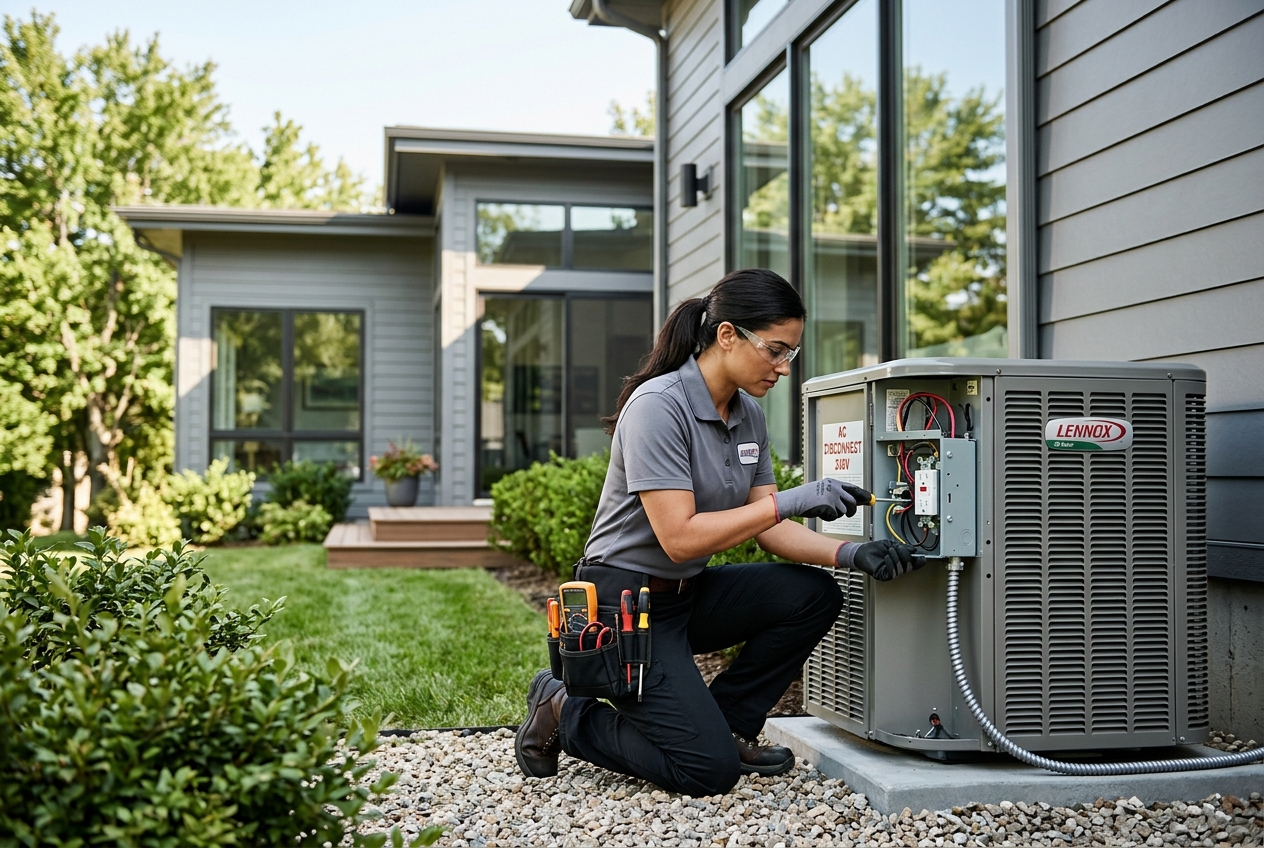
GFCI for HVAC: As of September 1, 2026, the NEC's temporary exception for listed outdoor HVAC equipment expires. In jurisdictions enforcing NEC Section 210.8(F) without an applicable amendment, listed outdoor HVAC equipment must have GFCI or qualifying SPGFCI protection.
Increased Costs: In jurisdictions where the requirement applies, homeowners installing or replacing covered outdoor HVAC equipment may face additional electrical costs. Costs vary depending on the protection method, electrical panel, wiring, labor rates, and local requirements.
Enhanced Safety: The primary benefit of the new GFCI requirement is significantly increased safety, reducing electrocution risks near outdoor units.
Arc Flash Labels: The 2026 NEC expands arc-flash hazard-marking requirements for certain non-residential equipment, promoting safer work practices for electrical professionals.
The 2026 edition of the National Electrical Code (NEC) brings important updates for residential electrical safety. Issued on September 9, 2025, this latest iteration of electrical safety standards focuses on enhancing protection, especially for outdoor HVAC units¹. Homeowners planning new HVAC installations or other electrical work should check which NEC edition and amendments apply locally. A temporary NEC exception for listed HVAC equipment expires September 1, 2026, but adoption and enforcement vary by jurisdiction².
The NEC sets the benchmark for safe electrical design, installation, and inspection across all 50 states³. Local jurisdictions adopt the NEC, sometimes with amendments, so specific effective dates and exact requirements can vary by location². The NEC is a model code rather than a federal mandate; states and local jurisdictions determine which edition and amendments they adopt and enforce.
GFCI Protection for Outdoor HVAC Units
Section 210.8(F) requires GFCI protection for covered outdoor dwelling-unit outlets. The 2026 NEC provides that, effective September 1, 2026, listed HVAC equipment must have GFCI or permitted Class C special-purpose GFCI (SPGFCI) protection⁴. Whether this requirement applies to a particular home depends on the NEC provisions adopted by the relevant jurisdiction. Section 210.8(F) was introduced in the 2020 NEC, but a later temporary exception exempted listed HVAC equipment from the requirement until September 1, 2026². Some jurisdictions have also amended, delayed, or limited Section 210.8(F).
How GFCI Protection Works
GFCIs are safety devices designed to protect against electric shock. They work by constantly monitoring the electrical current flowing through a circuit. If a GFCI detects an imbalance in current—meaning electricity is flowing along an unintended path, such as through a person—it quickly shuts off power². This rapid response helps prevent serious injury or electrocution, particularly in damp or wet environments where outdoor HVAC units are located.
The NEC added Section 210.8(F) in its 2020 edition, which applies to both receptacles and hard-wired outdoor equipment². The 2026 NEC retains Section 210.8(F) and provides GFCI or permitted Class C SPGFCI protection for listed HVAC equipment after the temporary exception expires.
Cost Implications for Homeowners
In jurisdictions where the requirement applies, homeowners installing or replacing covered outdoor HVAC equipment may face additional electrical costs associated with compliant GFCI or SPGFCI protection⁴. The estimated national average cost to install a GFCI circuit breaker starts at $307 to $373 per breaker as of May 2026 . For installing or replacing a GFCI outlet, homeowners can expect to pay $150 to $350⁵.
A new GFCI outlet with new wiring can range from $250 to $500 or more⁵. These estimates cover both the cost of the GFCI device and the labor for installation⁶.
The bulk of the cost for GFCI installation is labor, with electricians typically charging $95 to $140 per hour. If your home is older or has an outdated electrical panel, you might need panel upgrades or additional wiring to accommodate new GFCI breakers, which can increase costs further. Costs can increase if retrofit kits for older panels are needed. Permit and inspection fees, typically ranging from $25 to $90, can also increase costs⁷. To understand more about overall project costs, you can review our Electrical Wiring and Electrical Work guides.
Benefits and Challenges
The primary benefit for homeowners is significantly increased safety, reducing the risk of accidental electrocution when interacting with outdoor HVAC units, especially during maintenance or in wet conditions².
However, the HVAC industry, including organizations like ACCA and AHRI, has raised concerns about "nuisance tripping" with modern HVAC equipment, especially those with variable-speed compressors and inverters. Nuisance tripping can cause GFCI breakers to trip without an actual fault, leading to increased service calls and customer frustration if an air conditioner becomes inoperable during a heat wave. The NFPA approved a temporary exception until September 1, 2026, to allow for the development of special high-frequency (HF) GFCI devices to address nuisance tripping issues². As of September 2026, uncertainty remains regarding the widespread availability and proven performance of specialized GFCI devices to prevent nuisance tripping⁸.
Always verify which specific edition of the NEC your local jurisdiction has adopted². Code adoption and amendments can vary significantly by state and locality.
What Homeowners Need to Do
Compliance will necessitate professional electrical contractors who are knowledgeable about the 2026 NEC updates to ensure correct installation and wiring¹. Homeowners are advised to ask about the GFCI device, its location, and how to reset it, as nuisance trips may occur⁸.
Existing installations generally are not automatically required to be retrofitted solely because the NEC changes. However, replacement or modification of covered equipment may trigger current requirements depending on the NEC edition and amendments enforced by the local jurisdiction⁴. Homeowners should confirm requirements with their local building department or electrical inspector. Our guide on HVAC installation costs provides more context on overall system replacements.
Expanded Arc Flash Hazard Labeling
The 2026 NEC also expands arc-flash hazard-marking requirements for certain service and feeder equipment in buildings other than dwelling units. The 2026 NEC expands arc flash hazard labeling requirements by removing the 1,000-ampere threshold that previously limited detailed labeling to large service equipment. Section 110.16 now requires arc flash labels on nearly all non-residential service and feeder equipment, such as switchboards, switchgear, control panels, panelboards, and motor-control centers⁹.
Impact on Homeowners
Arc flash labels provide critical information for qualified personnel (electricians) regarding necessary personal protective equipment (PPE) and safe working practices⁷. Most residential homes are generally exempt from these expanded arc flash labeling requirements. The expanded arc flash labeling requirement applies to service and feeder equipment in buildings "other than dwelling units"⁹.
While homeowners are not expected to interact with energized electrical equipment, the presence of these labels on service panels, disconnects, or other critical electrical components will serve as a heightened visual reminder of the inherent dangers of electrical systems⁴. Expanded arc flash labeling indirectly benefits homeowners by promoting safer work practices by professionals⁷. The additional content related to arc flash labeling helps ensure the NEC keeps pace with modern electrical installations⁶.
The cost of the arc flash labels themselves is minimal. However, ensuring compliance with arc flash labeling requirements might be factored into overall project costs for significant electrical work or panel upgrades⁴.
Planning for Compliance
Projects involving new electrical installations or significant overhauls will be the most directly affected by the 2026 NEC updates⁴. The overarching goal of these NEC updates is to improve residential electrical safety nationwide¹.
Homeowners are strongly advised to hire licensed and insured electrical contractors who are current with the latest NEC code requirements to ensure installations are safe and compliant. Local building departments and electrical inspectors enforce the NEC edition and amendments adopted in their jurisdiction, including applicable permit and inspection requirements⁷. It is crucial for homeowners to verify what specific edition of the NEC their local jurisdiction has adopted, as code adoption varies significantly across states and localities, and some jurisdictions may amend or delay certain requirements².
The GFCI requirement for outdoor HVAC units officially becomes effective on September 1, 2026⁸. After this date, new installations will require GFCI protection.
Existing installations generally are not automatically required to be retrofitted solely because the NEC changes. However, replacement or modification of covered equipment may trigger current requirements depending on the NEC edition and amendments enforced by the local jurisdiction⁴. Homeowners should confirm requirements with their local building department or electrical inspector.
The estimated national average cost to install a GFCI circuit breaker starts at $307 to $373 per breaker as of May 2026 . A GFCI breaker itself typically costs $80 to $160 for 30- to 50-amp units⁷. Total installation costs can range from $250 to $500 or more, including labor⁵.
Nuisance tripping occurs when a GFCI breaker trips without an actual electrical fault, often due to how modern HVAC equipment with variable-speed compressors operates². This can cause inconvenience if the unit unexpectedly shuts off.
The 2026 NEC expands arc flash hazard labeling requirements, but most residential homes are generally exempt⁹. These labels are primarily for non-dwelling unit service and feeder equipment, providing critical safety information for qualified electricians⁷.
It is crucial to verify which specific edition of the NEC your local jurisdiction has adopted². Code adoption varies significantly, and some localities may amend or delay certain requirements. Contact your local building department or electrical inspector for specific information.
The rule applies to all outdoor HVAC equipment serving dwelling units that operates at 208V or 240V single-phase, rated 50 amps or less, including central air conditioners, mini-splits, and heat pumps⁴.
Homeowners should hire licensed and insured electrical contractors who are current with the latest NEC code requirements². They can ensure installations are safe and compliant with local regulations.
Will is a Home Improvement Editor with a passion for helping homeowners make confident, well-informed decisions about their homes. He specializes in reviewing and refining content covering home renovations, solar energy, roofing, HVAC, insulation, windows, flooring, plumbing, electrical systems, and other key areas of residential improvement.
With a strong background in research and technical writing, Will is committed to ensuring every article is accurate, accessible, and backed by reliable sources. He carefully reviews content for factual accuracy, clarity, readability, and relevance, helping readers understand complex home improvement topics in straightforward, practical terms. His editorial approach focuses on translating industry information into guidance that homeowners can trust when planning repairs, renovations, or energy-efficient upgrades.
Will has experience evaluating home improvement content against current industry standards, manufacturer guidance, and reputable government and consumer resources. He believes that high-quality editorial standards are essential in helping readers navigate major purchasing decisions, whether they are comparing roofing materials, selecting solar panels, upgrading insulation, or planning a complete home renovation.
As an editor, Will collaborates closely with writers and subject matter experts to ensure content remains comprehensive, unbiased, and up to date. He is particularly interested in emerging trends within the home improvement industry, including sustainable building practices, energy efficiency, smart home technology, and cost-effective renovation strategies that deliver long-term value for homeowners.
Outside of editing, Will enjoys staying informed about developments in residential construction, building products, and consumer technology. His attention to detail and commitment to producing trustworthy content help ensure readers have access to reliable information that empowers them to make informed decisions with confidence.
Sources:
9ba683603be9fa5395fab9018f6f8e4a (homedepot.com)
Sept. 1 Deadline Looms for Code Changes on Outdoor Outlets, GFCIs, 2026 (nahb.org)
NFPA 70 (NEC) Code Development (nfpa.org)
NEC 2026 GFCI Requirement for Outdoor AC Units: NJ Deadline Is September 1, 2026 (malfettoneelectric.com)
GFCI Outlet Installation Cost: How Many Do You Actually Need?, Dustin Ober, 2026 (integraelectrical.co)
What Changed in the 2026 NEC? (nfpa.org)
Cost to Replace GFCI Breaker: Professional Guide, 2026 (countbricks.com)
HVAC GFCI Deadline: Who Pays for Nuisance Trips?, Michael Jacobs, 2026 (blog.momoadvisors.com)
Nec 2026 Arc Flash Labeling Requirements (blog.supplyhouse.com)