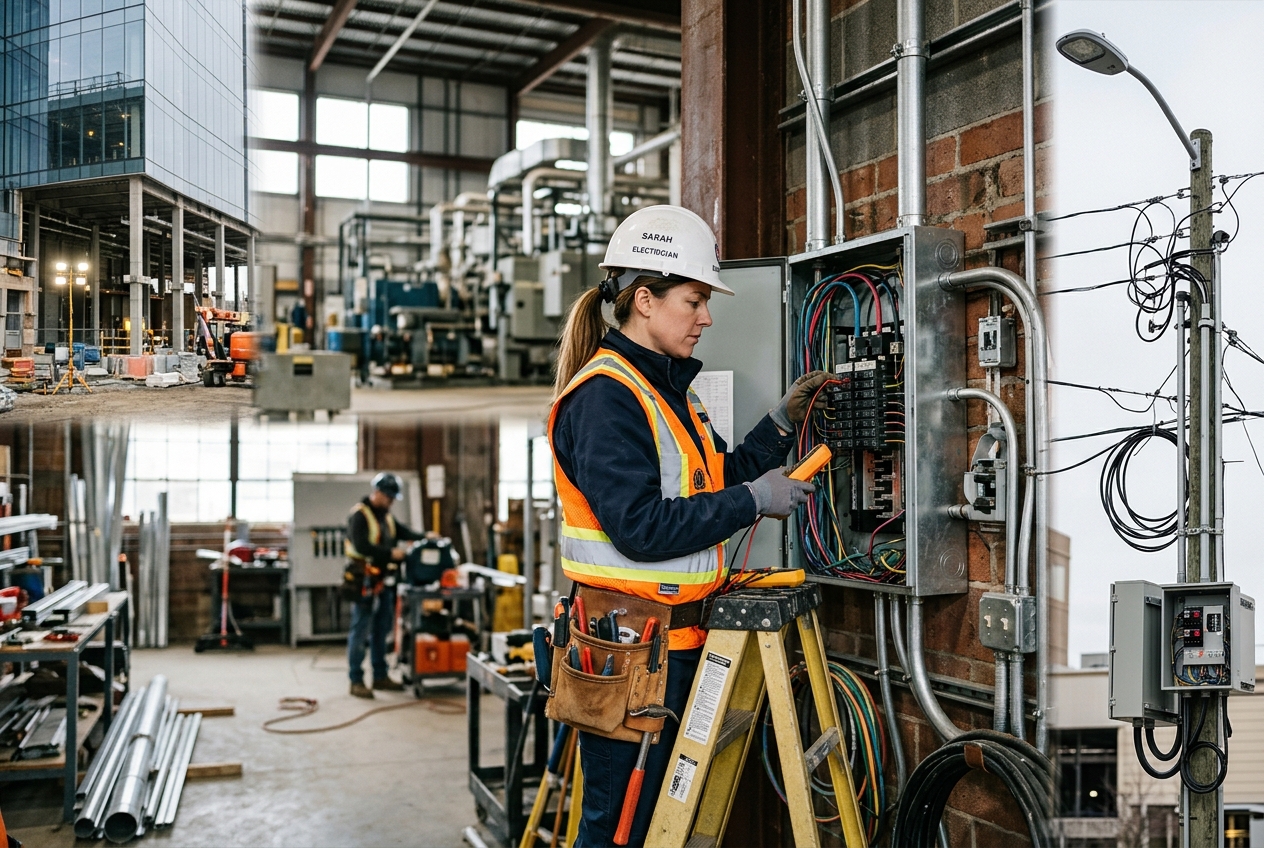
Diverse Roles: Electricians specialize across residential, commercial, industrial, and public/institutional sectors, each requiring distinct skills.
Core Duties: Common electrician duties include reading blueprints, installing wiring, inspecting components, and troubleshooting issues, although responsibilities vary by specialization.
Job Growth: The electrician field is projected to grow 9% from 2025 to 2035, driven by evolving power system demands and data center expansion.
Electricians install, maintain, and repair electrical power, communications, lighting, and control systems in various settings¹. The profession offers diverse specialization areas, each with unique demands and work environments. These specializations include residential, commercial, industrial, and public/institutional roles.
Common electrician duties include reading blueprints, installing wiring, inspecting components, and troubleshooting issues, although responsibilities vary by specialization. They also repair or replace wiring and equipment with specialized tools. Adherence to state and local building regulations, based on the National Electrical Code (NEC), is a fundamental requirement. Some experienced electricians also train and supervise other workers¹.[
Residential Electrician
Residential electricians focus on the electrical systems within homes. Their primary responsibilities include installing lighting fixtures, performing panel upgrades, and troubleshooting electrical issues specific to residential properties². This work often involves ensuring systems comply with safety standards for individual dwellings.
Work environments for residential electricians typically involve existing homes, new housing construction sites, and sometimes multi-family residential units. The work can range from routine maintenance to complex installations for remodels or additions.
Required skills for residential electricians include a strong understanding of household wiring systems, familiarity with common residential appliances, and the ability to diagnose and fix power outages or short circuits efficiently. Good customer service skills are also important.
Commercial Electrician
Commercial electricians work on electrical systems in commercial buildings such as offices, retail spaces, and restaurants. Their projects often involve large-scale wiring installations and the setup of backup power systems². This specialization often involves more complex power distribution systems and, depending on the project, communications infrastructure.
The work environments for commercial electricians vary from new commercial construction sites to ongoing maintenance in existing business premises. They often work on projects that involve extensive conduit systems and multiple power panels.
Key skills for commercial electricians include proficiency in installing large electrical panels, understanding commercial lighting control systems, and expertise in setting up data and communication lines. They must also be adept at reading intricate architectural and electrical plans for commercial structures.
Industrial Electrician
Industrial electricians specialize in the electrical systems found in manufacturing plants, factories, and other industrial facilities. Their expertise lies in working with heavy machinery, complex control systems, and high-voltage equipment². This area often demands a strong understanding of industrial automation, electrical control systems, and power distribution.
Industrial electricians typically work in environments with heavy machinery and specialized equipment. These settings often involve high-voltage systems and require strict adherence to industrial safety protocols. They might work in chemical plants, power generation facilities, or large-scale manufacturing operations.
Electricians benefit from strong critical-thinking skills, the ability to distinguish wire colors safely, and physical stamina for demanding work environments.
Required skills for industrial electricians include a mastery of motor controls, programmable logic controllers (PLCs), and three-phase power systems. They must also be capable of troubleshooting complex machinery and ensuring continuous operation in production environments.
Public/Institutional Electrician
Public/institutional electricians maintain electrical systems in public facilities such as schools, hospitals, government buildings, and transportation hubs. Their work often includes managing emergency power systems and ensuring strict adherence to public safety codes². This specialization emphasizes reliability and regulatory compliance.
Work environments for public/institutional electricians are diverse, ranging from educational campuses to healthcare facilities and municipal buildings. These sites often have critical electrical demands, such as life support systems in hospitals or security systems in government facilities.
Key skills for public/institutional electricians involve expertise in emergency generators, fire alarm systems, and public address systems. They must also possess a thorough understanding of accessibility codes and other regulatory requirements specific to public spaces.
Electrician Employment and Wages
The demand for electricians is projected to grow 9% from 2025 to 2035, which is much faster than the average for all occupations. This growth is fueled by the need to install and replace power systems, integrate new power generation sources like solar and wind into grids, and the increasing demand for data centers driven by artificial intelligence¹.[
According to the U.S. Bureau of Labor Statistics (BLS), the median annual wage for electricians in May 2025 was $63,190. The national mean annual wage for electricians was $71,490 in May 2025, as released by the BLS in May 2026³. Electricians in the lowest 10% income bracket earned less than $42,640 annually, while the highest 10% earned over $108,510 annually in May 2025¹.[
Choosing an Electrician Specialization
Choosing an electrician specialization depends on individual interests, aptitudes, and career goals. Each path offers unique challenges and opportunities. For those interested in the foundational training and licensing required, understanding the various stages of professional development is key. More information on this can be found in "Understanding the Electrician Near Me: Training, Licensing, and Career Path."
Pros
- + Diverse work environments provide varied experiences.
- + Specialization allows for focused skill development and higher expertise.
- + Projected employment growth offers promising career opportunities, although job demand varies by sector and location.
Cons
- - Each specialization requires specific training and knowledge.
- - Some roles involve more hazardous conditions or complex systems.
- - Adapting to new technologies requires continuous learning.
Understanding these distinct roles helps both aspiring electricians and clients seeking specialized expertise make informed decisions. The core duties of installing, maintaining, and repairing electrical systems remain consistent, but the application and complexity vary significantly across these specializations.
An electrician installs, maintains, and repairs electrical power, communications, lighting, and control systems. Their duties include reading blueprints, installing and maintaining wiring, inspecting electrical components, and identifying problems using testing devices.
In May 2025, the median annual wage for electricians was $63,190. The national mean annual wage was $71,490³.
The main types of electrician specializations include residential, commercial, industrial, and public/institutional roles. Each focuses on different electrical systems and work environments.
Electricians work in diverse environments, from new construction sites to existing buildings for maintenance and troubleshooting. This includes homes, offices, factories, and public facilities.
Essential qualities for electricians include the ability to distinguish wire colors safely, critical-thinking skills, and physical stamina. They must also adhere to state and local building regulations based on the National Electrical Code (NEC).
Yes, electrician employment is projected to grow 9% from 2025 to 2035, which is faster than the average for all occupations. This growth is driven by needs in power system installations, grid connections for new energy sources, and data center expansion¹.
Will is a Home Improvement Editor with a passion for helping homeowners make confident, well-informed decisions about their homes. He specializes in reviewing and refining content covering home renovations, solar energy, roofing, HVAC, insulation, windows, flooring, plumbing, electrical systems, and other key areas of residential improvement.
With a strong background in research and technical writing, Will is committed to ensuring every article is accurate, accessible, and backed by reliable sources. He carefully reviews content for factual accuracy, clarity, readability, and relevance, helping readers understand complex home improvement topics in straightforward, practical terms. His editorial approach focuses on translating industry information into guidance that homeowners can trust when planning repairs, renovations, or energy-efficient upgrades.
Will has experience evaluating home improvement content against current industry standards, manufacturer guidance, and reputable government and consumer resources. He believes that high-quality editorial standards are essential in helping readers navigate major purchasing decisions, whether they are comparing roofing materials, selecting solar panels, upgrading insulation, or planning a complete home renovation.
As an editor, Will collaborates closely with writers and subject matter experts to ensure content remains comprehensive, unbiased, and up to date. He is particularly interested in emerging trends within the home improvement industry, including sustainable building practices, energy efficiency, smart home technology, and cost-effective renovation strategies that deliver long-term value for homeowners.
Outside of editing, Will enjoys staying informed about developments in residential construction, building products, and consumer technology. His attention to detail and commitment to producing trustworthy content help ensure readers have access to reliable information that empowers them to make informed decisions with confidence.
Sources:
Electricians (bls.gov)
How to Become an Electrician: Step-by-Step Guide, Adam Wade, 2026 (sjvc.edu)
Electrician Salary by State: 2025 BLS Data & Pay Guide, 2026 (skilledtradesiq.com)