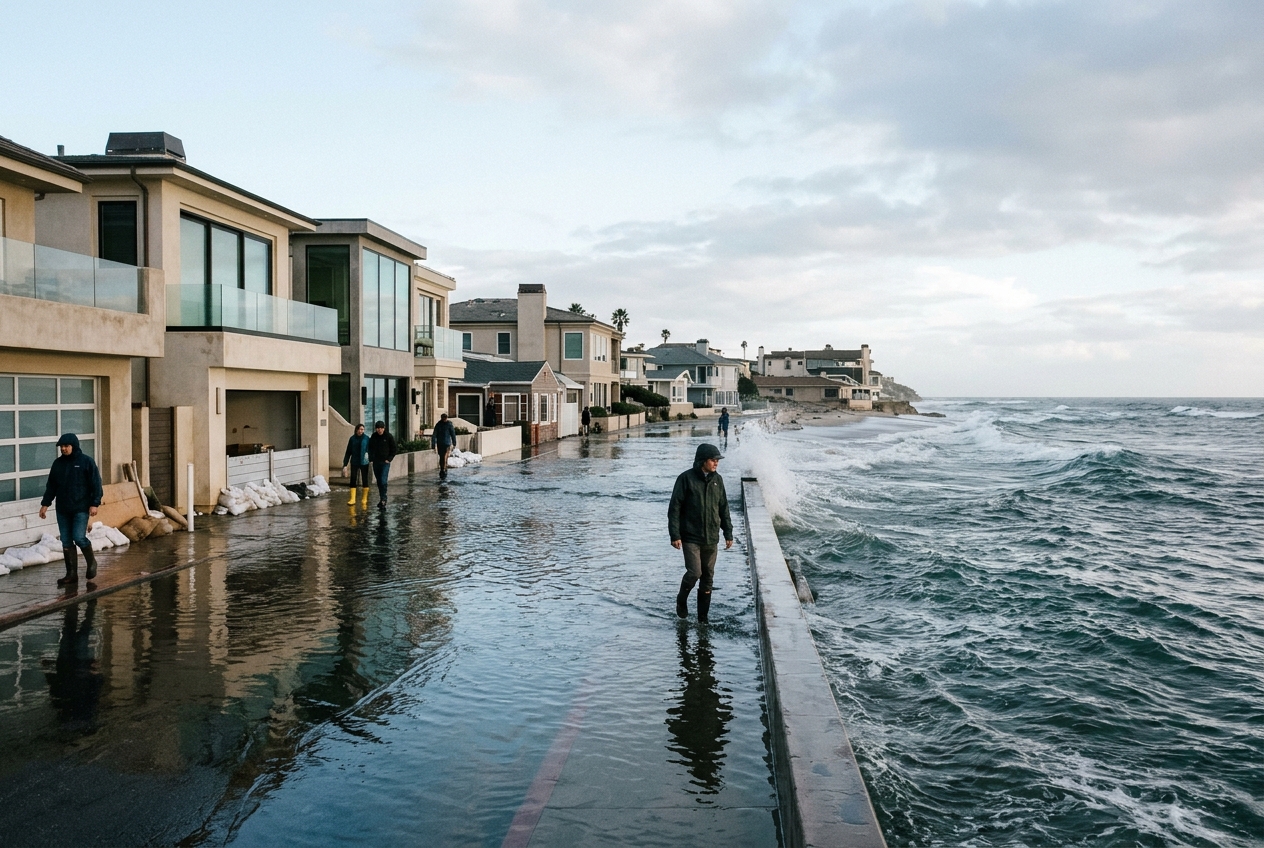
Record Inundation: California coastal communities are experiencing significant flooding in October 2026, driven by record high tides, a strong El Niño, and Kelvin waves.
Exacerbated Tides: The combination of King Tides, El Niño-induced Kelvin waves, and a strengthening El Niño is pushing water levels roughly 1 to 1.8 feet above predicted tides.
Widespread Impact: Homes, businesses, and infrastructure from San Diego to the San Francisco Bay Area have been inundated, leading to property damage and road closures¹.
California coastal communities are experiencing significant flooding in October 2026, marking days of inundation due to exceptionally high tides. This event is worsened by a strengthening El Niño and Kelvin waves. Seawater has surged into low-lying areas across the California coast, from San Diego to the San Francisco Bay Area¹.
This unusual combination of natural phenomena has resulted in record-breaking ocean levels. Property, including homes, businesses, and critical infrastructure, has been inundated by seawater. The National Weather Service (NWS) has issued flood advisories and warnings across California².
The Mechanics of California's Record High Tides
Several powerful oceanic and atmospheric forces are converging to create the current high tides along the California coast. These factors include king tides, an ongoing "super El Niño" event, and Kelvin waves. How these elements interact explains the extent of the present flooding.
King tides are a natural phenomenon caused by the gravitational pull and alignments of the Earth, moon, and sun. They occur several times a year and typically represent the highest tides of the season. The king tides in October 2026, however, have been particularly intense due to additional environmental factors³.
A "super El Niño" event is currently underway, warming the ocean and increasing seawater volume. This leads to higher-than-expected water levels. Ocean water levels in the California coastal region are approximately 15 to 22 inches (1 to 1.8 feet) higher than expected due to El Niño and Kelvin waves³.
Kelvin waves are series of warm water pulses that further contribute to lifting sea levels³. By the end of October 2026, some areas were already experiencing 18 inches of sea level rise⁴. The primary concern for California flooding around October 29, 2026, was these higher-than-normal tides, rather than a direct hit from an atmospheric river⁵. The NWS San Diego also noted that surf was not forecast to be elevated during this specific warning period, indicating the flooding was primarily tidal rather than wave-driven⁶.
In January 2026, a combination of king tides, climate change, and winter storms caused havoc in Marin County, leading to highway flooding and damage to hundreds of properties⁷.
Impact on Homes, Businesses, and Infrastructure
The current high tides are causing widespread damage and disruption across California's coast. Low-lying properties and critical infrastructure are directly affected, leading to property loss and interruptions in daily life.
In Huntington Beach, for example, six homes have been "yellow-tagged" (restricted use), and 114 structures have sustained damage². Residents have resorted to using sandbags, paddleboards, and surfboards to navigate flooded streets . Linda Holle, who works at a marine fueling station in Newport Beach, reported her office was flooded to an extent she had never witnessed before . In Sunset Beach, floodwaters overtopped three layers of sandbags, entering a studio apartment that had only flooded once in nearly three decades prior³.
Transportation corridors are also significantly impacted. Seawater has submerged streets and disrupted important transportation routes and train services. The Pacific Coast Highway was inundated, leading to stretches of it being closed³. In Marin County, cars became stuck on a flooded road, with paddleboarders moving past⁸. Kayakers and paddleboarders were seen gliding through typically busy thoroughfares. Several drivers needed rescue from their floating cars in Marin County¹. Specific street closures in Huntington Beach included Saybrook Lane and portions of Pacific Coast Highway². Highway 37 in the San Francisco Bay Area is particularly vulnerable to flooding .
Beyond immediate property damage, significant beach and shoreline erosion is likely across the California coast². Coastal erosion increases by over 69% during extreme El Niños, primarily driven by increases in wave stress and sea level⁹.
Forecasts and Warnings
The National Weather Service (NWS) has been actively issuing warnings and advisories. These forecasts indicate continued and potentially more severe flooding in the coming months.
A Coastal Flood Warning was in effect for San Diego and Orange counties through October 29, 2026, anticipating significant coastal flooding during morning high tides. The warning period for advisories was extended until Friday afternoon in Los Angeles, Ventura, and Santa Barbara counties, and until Thursday afternoon in Orange and San Diego counties². NWS San Diego forecasted tides 1 to 1.7 feet above astronomical predictions in its warning area. NWS Los Angeles/Oxnard expected late-morning high tides of 7.5–8 feet (referenced to Mean Lower Low Water), approximately 1 to 1.5 feet above astronomical projections⁶.
Record high tides were set this week in Santa Barbara, San Pedro, San Diego, and La Jolla³. The San Pedro tide gauge set back-to-back records, reading 8.02 feet on October 26 and 8.18 feet on October 27. The previous record was 7.93 feet in January 2005, and the gauge has kept records since November 1923⁸. Provisional NOAA readings on October 26 from San Diego Bay, La Jolla, and Los Angeles also exceeded their highest historical levels . San Francisco registered its highest reading for October, breaking a record set the previous day¹.
Pros
- + Advanced warnings allow for preparation and mitigation efforts.
- + Increased awareness of coastal vulnerabilities can lead to better long-term planning.
Cons
- - Forecasted continued flooding means ongoing disruption and potential damage.
- - Strengthening El Niño suggests future events could be even more severe.
Forecasters anticipate significant coastal flooding to continue. High tides during the late mornings are expected to generate significant coastal flooding through Friday, October 30, with tides 1.4 to 1.6 feet above astronomical predictions².
The current El Niño is predicted to strengthen into spring 2027. There is a high chance it could become a historically strong, or "super," El Niño, potentially surpassing previous events since 1950⁹. King tides during full moons in November and December 2026 could be more severe, potentially reaching nine feet or beyond when combined with an additional 1.5 feet of sea level rise from El Niño⁴. The California Office of Emergency Services has recommended precautions, including staying out of the water, avoiding driving through flooded roads, and monitoring local advisories².
King tides are the highest tides of the year, occurring when the Earth, moon, and sun align, creating a stronger gravitational pull. They are a natural, predictable phenomenon.
El Niño is a climate pattern that warms ocean waters. This warming increases seawater volume, leading to higher-than-expected sea levels and contributing to coastal flooding when combined with king tides.
Kelvin waves are warm water pulses that travel across the ocean. They further contribute to rising sea levels, intensifying the effects of king tides and El Niño.
Low-lying communities across the California coast, from San Diego to the San Francisco Bay Area, are experiencing significant flooding. This includes areas like Huntington Beach, Newport Beach, and Marin County.
Homes and businesses are being inundated by seawater, leading to property damage, restricted use of structures, and severe flooding of offices and residences.
The current El Niño is expected to strengthen into spring 2027, potentially becoming a "super El Niño." This means king tides in November and December 2026 could be even more severe, reaching nine feet or beyond.
The primary cause of the current flooding is higher-than-normal tides resulting from the full moon and El Niño-produced Kelvin waves. An atmospheric river was expected to deliver a glancing blow, but tidal forces are the main driver.
The California Office of Emergency Services recommends staying out of the water, avoiding driving through flooded roads, and monitoring local advisories and warnings from the National Weather Service.
Deana is a Home Improvement Editor with a passion for helping homeowners navigate renovation, repair, and remodelling with confidence. Specializing in roofing, kitchen and bath remodelling, and outdoor living spaces, she combines industry knowledge with a genuine commitment to making complex home projects feel approachable for readers at every stage of their journey.
Her path into home improvement media began after several years working alongside licensed contractors in project coordination, where she gained firsthand exposure to the realities of home renovation - from permitting delays to material sourcing challenges. This hands-on experience gave her a practical, ground-level understanding of what homeowners actually need to know before hiring a contractor, choosing materials, or starting a project - insight that now shapes every piece of content she creates.
As an editor, Deana oversees content covering product reviews, cost guides, seasonal maintenance tips, and contractor vetting advice, working closely with writers and industry experts to ensure accuracy and relevance. She has a particular interest in emerging trends like smart home technology and energy-efficient upgrades, and enjoys translating technical information into clear, actionable guidance for homeowners.
Beyond editorial oversight, Deana stays closely connected to the pulse of the home improvement industry - tracking shifts in consumer preferences, pricing trends, and the challenges homeowners face when navigating renovation projects, from budgeting to finding trustworthy professionals.
When not editing, Deana enjoys visiting local open houses for design inspiration and tackling small DIY projects around her own home. Based in Adelaide, Australia, she believes a well-maintained, thoughtfully upgraded home is one of the most meaningful investments people can make in their day-to-day quality of life.
Sources:
Record-breaking high tides spark chaos – and kayak commutes – across California, Gabrielle Canon, 2026 (theguardian.com)
Southern California coastal communities brace for more king tides, forcing street closures, 2026 (cbsnews.com)
El Niño Accelerates SoCal’s Beach Erosion Crisis, Zachary Plopper, 2026 (surfrider.org)
California Braces for Floods as Atmospheric River Threatens, admin, 2026 (claimsjournal.com)
High tides bring coastal flood alerts to California, Rishav Kothari, 2026 (watchers.news)
California Could See the Highest Sea Levels on Record This Year, Thanks to El Niño (kqed.org)
Coastal California braces for flooding amid forecast of ‘record-breaking tides’, Dani Anguiano, 2026 (theguardian.com)
California Coastal Commission (coastal.ca.gov)