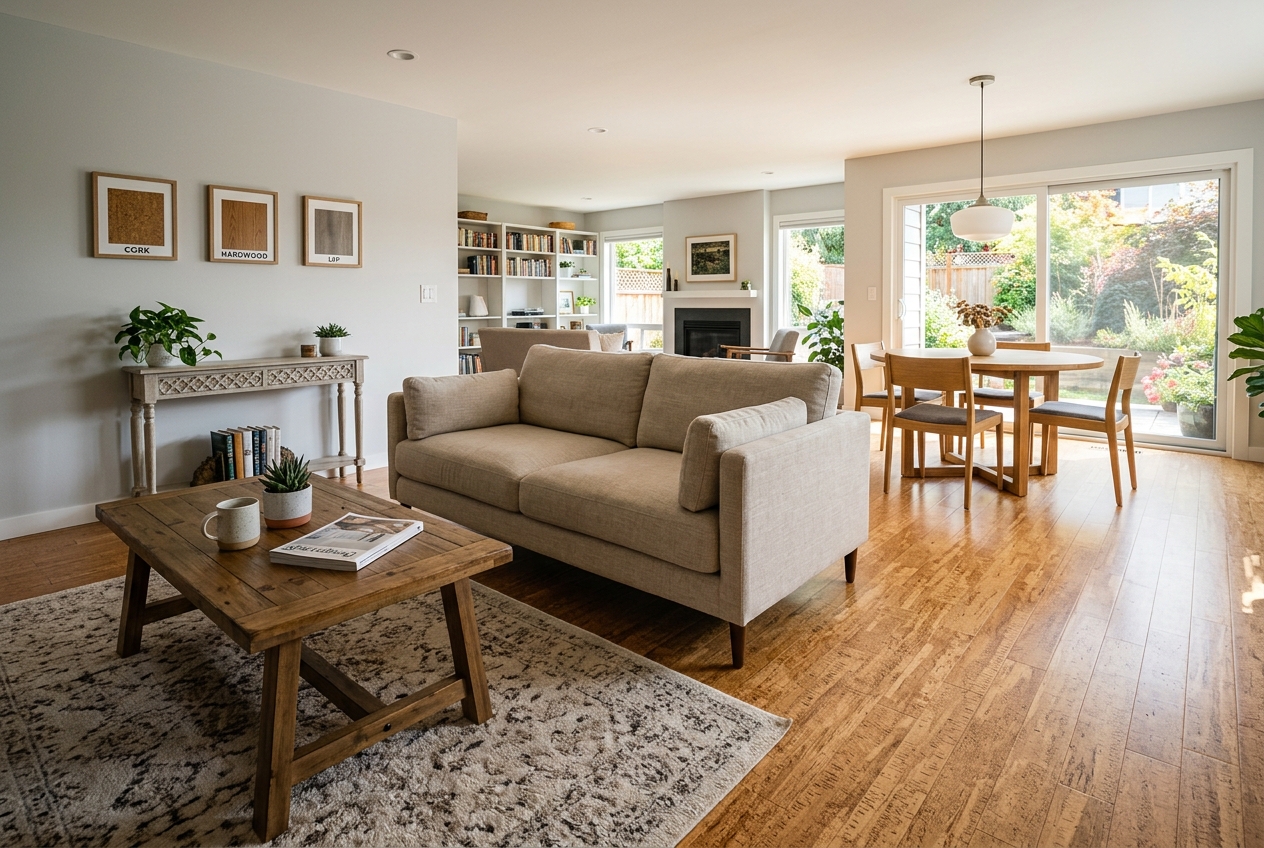
Lifespan: Cork flooring can last 30 to 40 years or more with proper maintenance, but requires regular sealing.
Refinishing: Solid cork flooring can be refinished to extend its life, unlike engineered cork with thin wear layers.
Hidden Savings: Cork offers natural thermal and sound insulation, which can reduce energy bills and improve comfort.
Upfront Costs: Hardwood, tile, and LVP generally have different initial costs, but cork offers unique long-term benefits.
Moisture: Cork is water-resistant, but requires careful sealing in high-moisture areas to prevent damage.
Homeowners often focus on upfront prices when choosing new flooring. However, understanding the long-term cost-effectiveness of different materials, including cork flooring cost, provides a more complete financial picture. This guide compares cork flooring against popular alternatives like hardwood, Luxury Vinyl Plank (LVP), tile, and carpet, focusing on lifespan, maintenance, and hidden savings.
Cork offers unique advantages in thermal and sound insulation, which can translate into significant energy savings and a more comfortable home environment over decades. Evaluating these less obvious benefits is crucial for making an informed decision.
Understanding Cork Flooring Costs and Lifespan
The initial cost of cork flooring is competitive, but its true value emerges over time. Proper maintenance significantly extends its lifespan and overall economic benefit.
Initial Costs and Installation
The direct cost to install cork flooring includes both material and labor. While specific figures can vary, homeowners should budget for professional installation to ensure longevity. You can find detailed estimates for Cork Flooring Installation which cover the average cost for materials and labor per square foot.
Lifespan and Maintenance
With proper care, cork flooring can last 30 to 40 years or more¹. In some cases cork flooring can last up to 100 years. However, without careful maintenance, its expected lifespan drops to 15 to 20 years².
Regular sealing is essential to protect cork from water damage. This process costs $0.30 to $0.70 per square foot and is needed every 3 to 10 years³. Solid cork flooring offers the advantage of being refinishable for $2 to $8 per square foot, a process that extends its life and avoids the higher cost of full replacement. Engineered cork with a thin surface layer, however, cannot typically be refinished¹.
Hidden Savings and Comfort
Cork's natural composition provides significant unseen benefits. Its honeycomb structure acts as a thermal insulator, helping to regulate floor temperatures and potentially leading to energy cost savings. This can lead to lower heating and cooling bills, contributing to long-term energy cost savings⁴.
Beyond energy efficiency, cork excels in sound insulation by absorbing both airborne and impact noise. It is also notably soft, warm, and cushioned underfoot, which helps reduce stress on joints⁴. These comfort and acoustic benefits contribute to a higher quality of life in the home.
While upfront cork flooring cost is a factor, consider cork's ability to lower energy bills and provide superior sound insulation over its long lifespan.
Cork Flooring vs. Other Popular Options
Comparing cork to other popular flooring types highlights its unique long-term value. Each material has different initial costs, maintenance needs, and hidden benefits.
Cork vs. Hardwood
Hardwood flooring typically has a higher upfront cost than cork. Material and labor for hardwood range from $6 to $25 per square foot⁵. You can find detailed costs for Hardwood Floor Installation.
While hardwood can last up to 100 years, cork is generally more affordable and offers better sound absorption and warmth⁵.
Pros
- + More affordable initial cost.
- + Better sound absorption.
- + Warmer and more cushioned underfoot.
Cons
- - Shorter maximum lifespan without diligent maintenance.
- - Requires regular sealing.
Cork vs. Luxury Vinyl Plank (LVP)
LVP generally has a lower initial cost than cork. Materials for LVP typically run $3 to $8 per square foot, with installed costs ranging from $2 to $14 per square foot⁵. Information on Luxury Vinyl Plank Flooring installation costs is available.
LVP is 100% waterproof, while cork is water-resistant. However, cork provides superior comfort, sound absorption, and is more eco-friendly than LVP⁶. LVP usually lasts 15 to 25 years, shorter than a well-maintained cork floor, and lacks cork's natural insulation properties for energy savings. Other vinyl options like Vinyl Plank Flooring or SPC Vinyl Flooring also offer varying costs and features.
Cork vs. Tile
Tile flooring comes with a higher initial cost than cork, with material and labor typically costing $15 to $20 per square foot⁵. Detailed costs for Tile Flooring Installation can provide further insight.
Tile boasts a longer lifespan, often 40-60+ years, and excellent durability. However, tile is hard, cold, and reflects sound. Cork is generally cheaper upfront and easier to install, offering comfort and energy efficiency that tile does not⁷.
Cork vs. Carpet
Carpet usually has a lower initial cost than cork, with installed costs ranging from $3.50 to $11 per square foot⁵.
Carpet needs replacement every 10-15 years, and professional deep cleaning adds to its long-term costs. Cork offers excellent sound insulation, similar to carpet⁸, but with a much longer lifespan and easier maintenance in the long run.
Best Areas for Cork Flooring
Cork's characteristics make it suitable for specific areas within the home where its benefits are most appreciated.
Cork works well in kitchens, bedrooms, home offices, and playrooms. Its comfort and sound control are particularly advantageous in these spaces.
The cushioning reduces fatigue in kitchens, while sound absorption improves acoustics in bedrooms and offices.³
Cork is naturally water-resistant due to suberin, a waxy substance in its composition. However, it is not waterproof. Proper sealing is essential for cork flooring in moisture-prone areas like bathrooms and kitchens to prevent water damage. Some sources suggest caution in high-moisture areas like bathrooms, while others suggest specific cork tiles are ideal with proper sealing and installation⁴.
Overall Recommendation
For homeowners prioritizing long-term value, comfort, and environmental benefits, cork flooring is an excellent choice. While its initial cost may be higher than some budget options like LVP or carpet, its impressive lifespan, refinishing potential, and hidden savings from thermal and sound insulation make it cost-effective over decades.
If a truly waterproof solution is paramount, LVP might be a better fit. However, if warmth, quiet, and a sustainable material with a long service life appeal, the long-term value of cork flooring often outweighs its upfront investment.
The cost of cork flooring, including materials and installation, varies. For detailed figures, consult specific cost guides like the one for Cork Flooring Installation.
With proper maintenance, cork flooring can last 30 to 40 years or more. Without diligent care, its lifespan typically shortens to 15 to 20 years².
Yes, solid cork flooring can be refinished for $2 to $8 per square foot, significantly extending its lifespan. Engineered cork with a thin wear layer generally cannot be refinished.
Yes, cork flooring offers excellent sound insulation by absorbing both airborne and impact noise, making it a good choice for quieter living spaces.
Cork's natural honeycomb structure provides thermal insulation, which helps regulate floor temperature and can lead to energy cost savings over time.
LVP typically has a lower initial cost and lasts 15 to 25 years. Cork, while potentially more expensive upfront, can last 30-40+ years¹ and offers better insulation and comfort.
Cork is water-resistant, but not waterproof. Proper sealing is critical for cork flooring in kitchens and other moisture-prone areas to prevent water damage⁴. Some specific cork tiles may work in bathrooms with careful installation.
Cork offers excellent sound insulation, similar to carpet, but boasts a much longer lifespan (30-40+ years vs. 10-15 years for carpet) and easier long-term maintenance, without the need for frequent deep cleaning⁸.
Deana is a Home Improvement Editor with a passion for helping homeowners navigate renovation, repair, and remodelling with confidence. Specializing in roofing, kitchen and bath remodelling, and outdoor living spaces, she combines industry knowledge with a genuine commitment to making complex home projects feel approachable for readers at every stage of their journey.
Her path into home improvement media began after several years working alongside licensed contractors in project coordination, where she gained firsthand exposure to the realities of home renovation - from permitting delays to material sourcing challenges. This hands-on experience gave her a practical, ground-level understanding of what homeowners actually need to know before hiring a contractor, choosing materials, or starting a project - insight that now shapes every piece of content she creates.
As an editor, Deana oversees content covering product reviews, cost guides, seasonal maintenance tips, and contractor vetting advice, working closely with writers and industry experts to ensure accuracy and relevance. She has a particular interest in emerging trends like smart home technology and energy-efficient upgrades, and enjoys translating technical information into clear, actionable guidance for homeowners.
Beyond editorial oversight, Deana stays closely connected to the pulse of the home improvement industry - tracking shifts in consumer preferences, pricing trends, and the challenges homeowners face when navigating renovation projects, from budgeting to finding trustworthy professionals.
When not editing, Deana enjoys visiting local open houses for design inspiration and tackling small DIY projects around her own home. Based in Adelaide, Australia, she believes a well-maintained, thoughtfully upgraded home is one of the most meaningful investments people can make in their day-to-day quality of life.
Sources:
Cork Flooring Pros And Cons (homeguide.com)
All About Cork Flooring, Josh Garskof, 2026 (thisoldhouse.com)
Cork Flooring Cost (angi.com)
One moment, please... (todayshomeowner.com)
What Does Cork Flooring Cost? [2025 Data] (homeadvisor.com)
Cork vs LVP Flooring (2026 Comparison), 2026 (elsocontracting.com)
Cork Flooring vs Tile: Cost Analysis and Long-Term Value (portuguesetreasures.com)
Cork Flooring vs Carpet: Cost Analysis and Long-Term Value (portuguesetreasures.com)