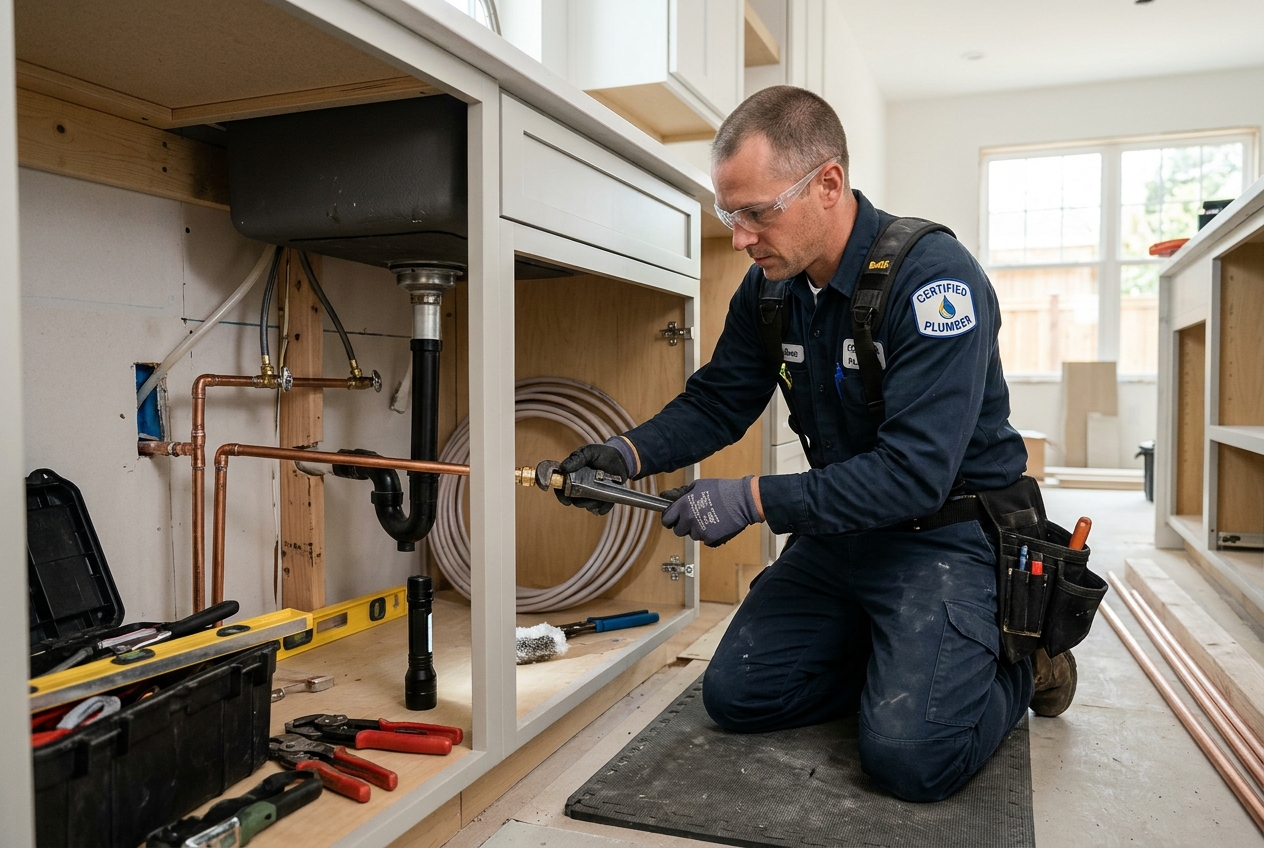
Licensing Varies: Plumber licensing is regulated at state, county, or municipal levels, not federally. Most states require a statewide license.
Progression: Plumbers advance from apprentices to journeymen, and then to master plumbers, each requiring specific training and experience.
Why Hire Licensed: Licensed plumbers ensure code compliance, carry insurance, and provide warranties, protecting homeowners from liability and poor workmanship.
Plumber licensing in the US is regulated at state, county, or municipal levels, not federally . Most US jurisdictions, 45 out of 51, require a statewide plumber license, while six states defer licensing to local authorities. An examination is mandated for licensing in every jurisdiction that requires a license¹.
Hiring a licensed plumber is crucial for any home or business plumbing project. These professionals offer expertise, ensure compliance with local codes, and provide essential protections like insurance and warranties. Understanding their training and licensing process helps homeowners make informed decisions.
The Path to Becoming a Licensed Plumber
Becoming a licensed plumber is a multi-stage process involving significant training, experience, and examinations. This progression ensures plumbers gain comprehensive knowledge and practical skills before working independently. A high school diploma or GED is typically required to start this career .
Apprentice Plumber
Most plumbers begin their careers through a paid apprenticeship, which typically lasts 4 to 5 years. During this period, an apprentice works under the direct supervision of a licensed journeyman or master plumber. Apprenticeships involve about 2,000 hours of on-the-job training and technical instruction annually¹.
The technical instruction covers essential subjects like safety protocols, local building codes, blueprint reading, mathematics, physics, and chemistry¹. These foundational skills are critical for safe and effective plumbing work.
Journeyman Plumber
After completing an apprenticeship and gaining 2 to 5 years of experience, individuals must pass a state-issued licensing exam to become a journeyman plumber. A journeyman plumber can work independently, performing a wide range of plumbing tasks. However, in some states, they may have restrictions on pulling permits or supervising apprentices¹.
The national median annual wage for plumbers, pipefitters, and steamfitters was $63,800, or $30.67 per hour, according to May 2025 BLS data. Estimated annual earnings for journeymen plumbers in 2026 range from $57,000 to $79,500².
Master Plumber
Achieving master plumber status requires further experience, typically 2 to 5 years as a journeyman, and passing a more difficult examination. Master plumbers have the highest level of licensing. They can supervise other plumbers, pull permits for projects, and operate their own plumbing business¹.
Plumbing contractors often need to employ a licensed master plumber and meet specific financial and insurance requirements to operate legally¹. Master plumbers' estimated annual earnings in 2026 range from $61,500 to $105,000. Plumbing business owners can earn significantly more, from $60,000–$120,000 for solo plumbers to over $200,000–$500,000+ for established companies².
Why Hire a Licensed Plumber?
Hiring a licensed plumber offers significant advantages and protections for homeowners. Their qualifications ensure the work meets professional standards and complies with regulations.
Pros
- + Ensures compliance with local plumbing and building codes, helping work pass inspection.
- + Licensed plumbers carry contractor's insurance, protecting homeowners in case of accidents or damage during a job.
- + They provide warranties and guarantees for both parts and labor, offering peace of mind³.
- + Possess crucial knowledge of local building codes and stay updated through continuing education⁴.
- + Know how to install the latest plumbing products and technologies according to manufacturer instructions .
Cons
- - May have higher hourly rates compared to unlicensed individuals, reflecting their training, insurance, and compliance costs.
- - Requires verifying their license and insurance credentials before hiring.
Beyond compliance and protection, licensed plumbers offer a wide range of services. These include new installations, system upgrades, preventative maintenance, and emergency services. Specific services cover water heater repair or replacement, drain cleaning, sewer line services, fixture installation, re-piping, leak detection, and sump pump replacement⁵. Plumbers can also consult on efficient plumbing solutions³.
Always ask to see a plumber's license and proof of insurance. This simple step confirms their qualifications and protects you from potential liabilities.
Understanding Plumber Costs
The cost of hiring a plumber varies based on their experience level, the service needed, and the urgency of the job. Understanding these factors helps in budgeting for plumbing projects. For more detailed information on service fees and preventative care, see our guide on Managing Plumbing Services Costs: Preventative Care and Emergency Strategies.
Hourly Rates
Standard plumbers typically charge $75 to $150 per hour in 2026. Master plumbers, due to their advanced expertise, command higher rates, usually $100 to $200 per hour in 2026⁶. These hourly rates refer to the plumber's wage; the customer-facing billable rate covers overhead and profit².
Hourly rates also vary by region :⁶
High-cost metros: $150–$225 per hour
Major metros: $100–$150 per hour
Rural markets: $70–$100 per hour
In addition to hourly rates, plumbers often charge a service call or trip fee, ranging from $75 to $300⁵. This fee is frequently applied toward the total repair cost.
Flat-Rate Pricing for Common Jobs
Many plumbers offer flat-rate pricing for common jobs, providing predictable costs for homeowners⁵. This approach often excludes materials and permits, which are almost always extra .
Camera inspection for clogged drains typically costs more than snaking alone⁵.
Emergency Plumbing Costs
True plumbing emergencies involve urgent issues like uncontrollable leaks, sewage backups, complete loss of water, active flooding, or a gas smell (always call the utility company first for gas issues). For non-emergencies such as slow drains or dripping faucets, it is usually better to wait for normal business hours⁷.
Emergency plumbing services generally cost more due to immediate response and after-hours availability. Rates can be 1.5 to 3 times higher than standard rates⁵. Emergency hourly rates range from $100 to $500 per hour, potentially reaching $600 for holiday or after-hours calls . Some sources indicate emergency calls cost $150–$450 per hour⁷.
Emergency service call fees are typically $100 to $300. After-hours and weekend dispatch fees are usually an additional $150 to $300⁵. After-hours emergency service (night or weekend) for a common repair may range from $300 to $700, including a $150–$300 trip charge plus labor at 1.5x to 2x the standard rate. Holiday rates can have labor multipliers of 2x to 3x standard rates⁸.
Typical emergency repair costs include:
Running toilet at 11 PM: $350 to $500
Accessible burst pipe: $500 to $1,000
Emergency water heater replacement: $1,200 to $2,500
Emergency sewer backup snaking: $400 to $800⁸
Materials and parts are usually marked up over the plumber’s cost, and the markup can be higher in emergency situations due to the immediate need for availability⁸. Factors affecting plumbing costs include access difficulty, specific parts and materials, permit requirements, the time of day or urgency, and the plumber's experience and license level⁵.
Homeowner's Insurance and Plumbing Issues
Homeowners insurance generally covers "sudden and accidental" plumbing issues, such as burst pipes or failed water heaters. Coverage typically applies to water damage caused by a sudden leak to areas like walls and floors. However, it usually does not cover the cost of repairing the damaged plumbing component itself, unless the pipes are damaged by a covered peril like fire or storm⁹.
Damage from gradual leaks, wear and tear, long-term neglect, or preventable maintenance issues is typically not covered. Homeowners insurance coverage for mold resulting from a covered leak may also have limits. Add-ons like water backup coverage can extend protection to issues arising from sump pump failure or drain backups⁹.
Regular professional maintenance by a plumber can keep systems in order, identify issues early, and advise on optimal organization for accessibility and efficiency³. For more on preparing for emergencies, read Emergency Plumber: What to Do Before They Arrive.
Conclusion: Prioritize Licensed Professionals
Hiring a licensed plumber is a critical decision for any homeowner. The rigorous training and licensing process ensures they possess the necessary skills and knowledge to perform work safely, effectively, and in compliance with local codes. From handling complex installations to addressing emergencies, a licensed professional provides peace of mind through insurance, warranties, and adherence to industry standards. Prioritizing licensed plumbers protects your home, your investment, and your family's safety. For further guidance on selecting a plumber, refer to Finding a Plumber Near Me: Urgent and Routine Plumbing Needs.
Becoming a plumber typically starts with a high school diploma or GED , followed by a 4-to-5-year paid apprenticeship. Apprentices receive 2,000 hours of on-the-job training and technical instruction annually, covering safety, codes, blueprint reading, and more. After this, they pass a state exam to become a journeyman, and further experience and another exam lead to master plumber status.
The national median annual wage for plumbers, pipefitters, and steamfitters was $63,800 or $30.67 per hour, according to May 2025 BLS data. Estimated annual earnings in 2026 are $37,000–$47,500 for apprentices, $57,000–$79,500 for journeymen, and $61,500–$105,000 for master plumbers².
Homeowners insurance generally covers "sudden and accidental" plumbing problems, such as burst pipes or water damage from a failed water heater. However, it typically does not cover the cost of repairing the damaged plumbing component itself, or damage resulting from gradual leaks, wear and tear, or neglect⁹.
For tougher clogs or main sewer line issues, professional plumbers use industrial-grade snakes, augers, camera inspection, and hydro-jetting to safely remove blockages that household tools cannot handle.
Key plumbing maintenance tips include knowing the location of your main shut-off valve, fixing leaks promptly, avoiding flushing inappropriate items, using drain strainers, monitoring water pressure, insulating exposed pipes, and scheduling annual professional inspections .
A journeyman plumber can work independently but may have restrictions on pulling permits or supervising apprentices in some states. A master plumber has reached the highest licensing level, allowing them to supervise other plumbers, pull permits for any project, and operate their own plumbing business.
No, plumbing licensing is regulated at state, county, or municipal levels in the US, not federally . Most states require a statewide license, but some jurisdictions defer licensing to local authorities¹.
Emergency plumbing services cost more due to the immediate response required and after-hours availability⁷. Rates can be 1.5 to 3 times higher than standard rates, with additional dispatch fees for nights, weekends, and holidays⁵. Materials may also have a higher markup due to immediate availability⁸.
Deana is a Home Improvement Editor with a passion for helping homeowners navigate renovation, repair, and remodelling with confidence. Specializing in roofing, kitchen and bath remodelling, and outdoor living spaces, she combines industry knowledge with a genuine commitment to making complex home projects feel approachable for readers at every stage of their journey.
Her path into home improvement media began after several years working alongside licensed contractors in project coordination, where she gained firsthand exposure to the realities of home renovation - from permitting delays to material sourcing challenges. This hands-on experience gave her a practical, ground-level understanding of what homeowners actually need to know before hiring a contractor, choosing materials, or starting a project - insight that now shapes every piece of content she creates.
As an editor, Deana oversees content covering product reviews, cost guides, seasonal maintenance tips, and contractor vetting advice, working closely with writers and industry experts to ensure accuracy and relevance. She has a particular interest in emerging trends like smart home technology and energy-efficient upgrades, and enjoys translating technical information into clear, actionable guidance for homeowners.
Beyond editorial oversight, Deana stays closely connected to the pulse of the home improvement industry - tracking shifts in consumer preferences, pricing trends, and the challenges homeowners face when navigating renovation projects, from budgeting to finding trustworthy professionals.
When not editing, Deana enjoys visiting local open houses for design inspiration and tackling small DIY projects around her own home. Based in Adelaide, Australia, she believes a well-maintained, thoughtfully upgraded home is one of the most meaningful investments people can make in their day-to-day quality of life.
Sources:
Plumber License Requirements by State (2026): Hours, Exams & Fees, 2026 (gettradelicense.com)
Plumber Salary Guide: How Much Do Plumbers Make? 2026 (fieldcamp.ai)
The Benefits Of Hiring A Plumbing Contractor (petes-plumbing.com)
Plumbing Usa What Are The Key Skills And Qualifications Needed To Thrive As A Plumber In The USA And Why Are They Important (ziprecruiter.com)
How Much Does a Plumber Cost in 2026 (Real Price Ranges by Job), Bob Olson, 2026 (rtolsonplumbing.com)
Plumber Rates by State: Wages + Billing Calculator, TradeShield, 2026 (tradeshieldsolutions.com)
Emergency Plumbing Cost in 2026: Rates and Surcharges, 2026 (costrepairguide.com)
Emergency Plumber Cost 2026: Real Prices + Cheaper Alternative, Mike Giles, 2026 (helpbyexperts.com)
Does Homeowners Insurance Cover Plumbing (thezebra.com)